
SUMMARY BACKGROUND
SUMMARY BACKGROUND
Where We Stand: Defining the Capital Region
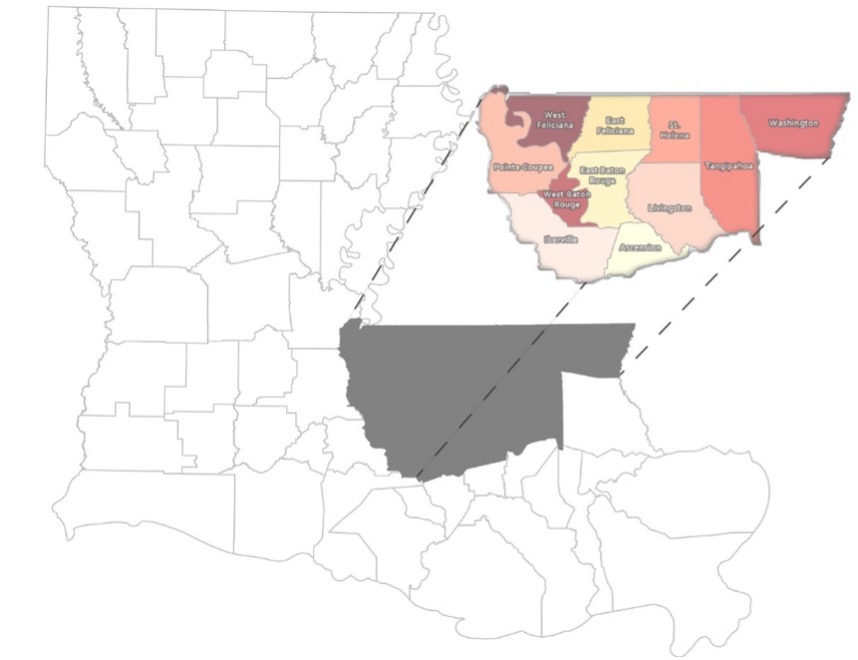
The Capital Region Planning Commission (CRPC), headquartered in Baton Rouge, serves as the designated Economic Development District (EDD) by the U.S. Economic Development Administration (EDA) for an 11-parish region in southeastern Louisiana. This expansive region includes Ascension, East Baton Rouge, East Feliciana, Iberville, Livingston, Pointe Coupee, St. Helena, Tangipahoa, Washington, West Baton Rouge, and West Feliciana Parishes. CRPC also functions as the region’s Metropolitan Planning Organization (MPO), responsible for transportation planning in urbanized portions of five of these parishes.
Geographically positioned along both sides of the Mississippi River, the Capital Region is strategically situated as a vital economic and transportation hub in the state. The region forms one-half of Louisiana’s “Super Region,” which includes the Baton Rouge and New Orleans Metropolitan Statistical Areas (MSAs). Nine of CRPC’s parishes are within the Baton Rouge MSA, while Tangipahoa Parish constitutes its own MSA and Washington Parish is designated as a rural, non-MSA area.
POPULATION GROWTH
The Capital Region exhibits diverse demographic and economic trends across its 11 parishes. Since the 2020 Census, Livingston and Ascension Parishes have led in population growth, increasing by 7.5% and 5.6%, respectively. In contrast, seven of the 11 parishes-including Iberville, West Feliciana, and East Baton Rouge-have experienced population declines.


JOB GROWTH
The Region demonstrates a strong industrial base, with multiple sectors showing Location Quotients (LQs) above the national average. Goods-producing industries are especially concentrated in Iberville, West Baton Rouge, and Ascension, driven by manufacturing and construction. Construction shows high specialization across both urban and rural areas, while natural resources and mining are prominent in Pointe Coupee and St. Helena. Trade, transportation, and utilities also exceed national benchmarks in several parishes. These patterns reflect the region’s economic diversity and continued investment in infrastructure and advanced industries, supporting long-term growth and resilience.
INDUSTRY CLUSTERS
CRPC plays a vital coordinating role in regional planning and economic development efforts, providing technical assistance, data analysis, and strategic guidance to its member governments. As part of its responsibilities, CRPC updates the Comprehensive Economic Development Strategy (CEDS) every five years to reflect the region’s evolving conditions, goals, and opportunities. This plan not only guides EDA grant eligibility but also shapes broader initiatives in workforce development, entrepreneurship, transportation, land use, and environmental resilience.
With strong connections to statewide and federal agencies, CRPC leverages regional strengths to foster inclusive, sustainable growth. The Commission’s commitment to collaboration, data-driven decision-making, and equitable development continues to position the Capital Region as a competitive and resilient leader in the southeastern United States.
